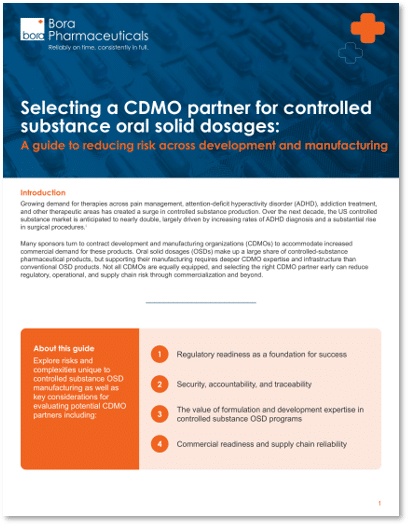
Selecting the right CDMO partner for controlled substance oral solid dose (OSD) products requires careful consideration of regulatory requirements, technical expertise, operational infrastructure, and commercial readiness. Compared with conventional OSD manufacturing, controlled substance programs introduce additional complexities related to security, material accountability, formulation development, and supply chain management. Evaluating these capabilities early can help sponsors reduce risk and establish a more reliable path to commercialization.
Controlled substance OSD manufacturing requires CDMOs to navigate both pharmaceutical quality standards and Drug Enforcement Administration (DEA) requirements. However, regulatory compliance alone does not guarantee that a CDMO is prepared to support every controlled substance program. Sponsors must also consider how security, traceability, quality systems, and operational controls are integrated throughout development and manufacturing.
This guide examines the key considerations for evaluating potential controlled substance CDMO partners, from regulatory readiness and material accountability to formulation expertise, scale-up capabilities, and commercial supply planning. It also outlines practical questions sponsors can use to assess whether a CDMO has the experience, infrastructure, and processes needed to support their specific program requirements.
Readers will also learn how Bora Pharmaceuticals supports controlled substance OSD programs at its Maple Grove, Minnesota facility. With dedicated suites and handling infrastructure for DEA Schedule II-V controlled substances, quota management expertise, and experience in modified-release technologies and complex formulations, Bora provides capabilities to support controlled substance development and manufacturing programs.